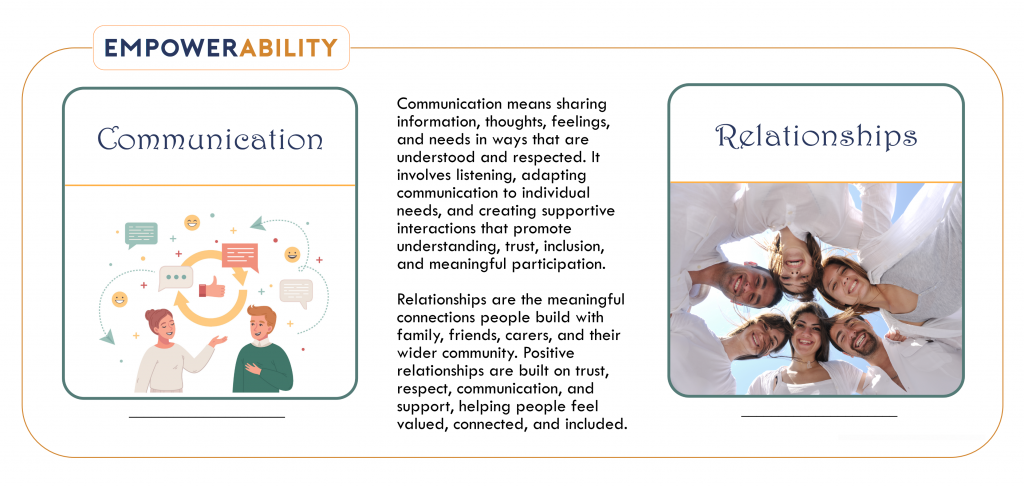
Building trust, connection, and understanding
At EmpowerAbility, we believe great support begins with great relationships.
Support is much more than completing tasks or following procedures. Instead, it is about helping people feel heard, understood, respected, and valued.
Because of this, the way we communicate often has a greater impact than any policy or system.
When people feel listened to, trust grows. As trust grows, confidence increases. In turn, people are more likely to feel safe, independent, and able to achieve their goals.
What this standard means
Definition
This standard promotes clear communication, positive relationships, emotional safety, and healthy professional boundaries.
Above all, it encourages support that strengthens human connection while respecting each person’s individuality.
Why it matters
Poor communication can lead to:
- misunderstanding
- frustration
- conflict
- anxiety
- reduced trust
- emotional distress
As a result, people may become isolated, disengaged, or less willing to ask for help.
On the other hand, when communication is open and respectful, people are more likely to experience:
- trust
- confidence
- emotional safety
- wellbeing
- cooperation
- meaningful involvement
Good communication helps people live better lives.
Core principle
At EmpowerAbility, we believe people thrive when they feel heard, understood, and valued.
Therefore, support should never become purely task-focused.
Instead, every interaction should strengthen trust and build positive relationships.
Understanding communication and relationships
Communication

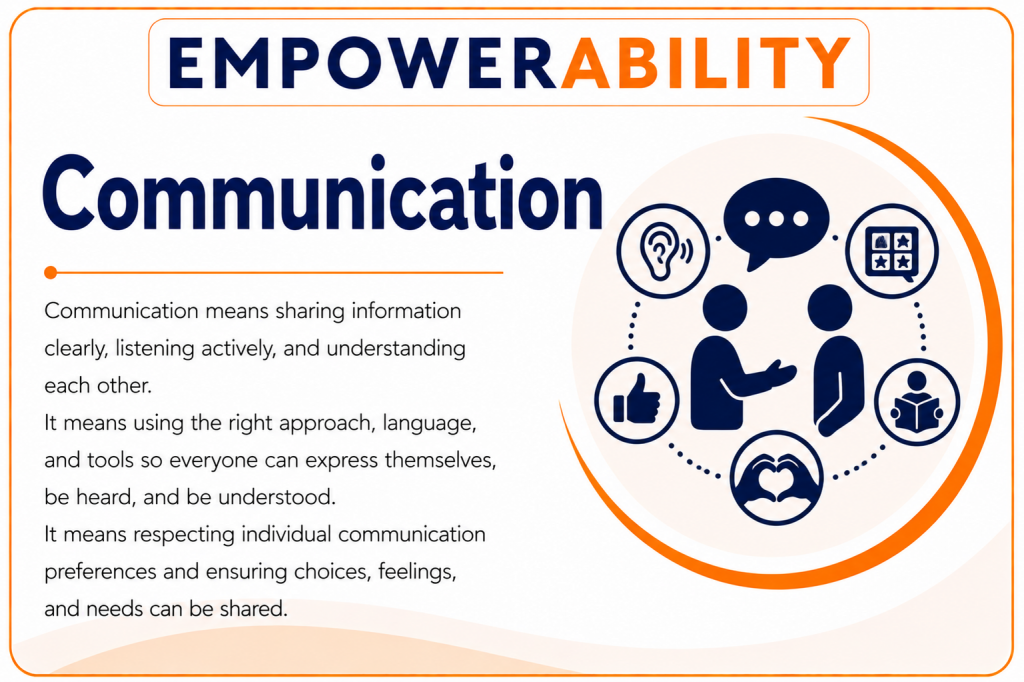
Communication is much more than talking.
People communicate through:
- speech
- body language
- facial expressions
- behaviour
- gestures
- writing
- symbols
- communication aids
- silence
Therefore, good communication means both speaking clearly and listening carefully.
The goal is shared understanding.
Relationships
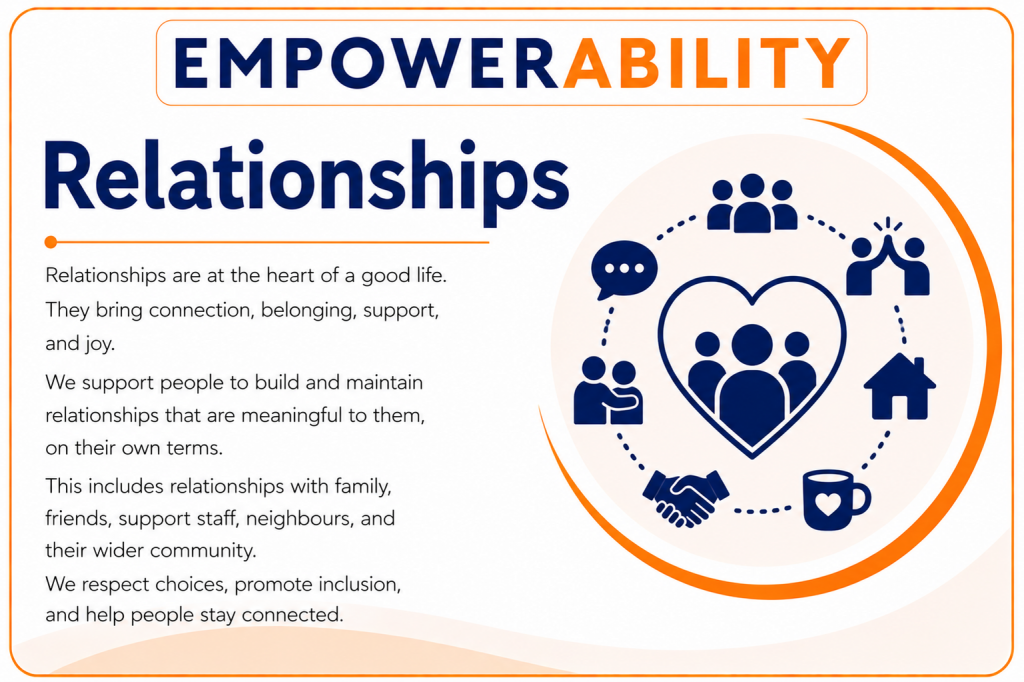
Healthy support relationships should be:
- respectful
- consistent
- trustworthy
- compassionate
- person-centred
- professional
As a result, people feel safer, more confident, and better supported.
Required outcomes
Communication needs are understood
Support should recognise each person’s communication needs, strengths, and preferences.
Whenever necessary, communication should be adapted to suit the individual.
Communication is accessible
Information should always be easy to understand.
For example, this may include:
- plain English
- Easy Read information
- pictures or symbols
- communication technology
- written reminders
- visual supports
Accessible communication helps people take part in decisions about their own lives.
People feel heard
People should feel listened to and taken seriously.
In addition, they should know that their views and experiences matter.
Feeling heard builds trust and strengthens relationships.
Trust is built
Trust develops over time through:
- honesty
- reliability
- empathy
- consistency
- confidentiality
- keeping promises
Everyday actions build lasting trust.
Emotional safety is protected
People should feel safe expressing their thoughts, feelings, and concerns.
They should never fear humiliation, intimidation, or manipulation.
Respectful communication creates emotional safety.
Professional boundaries are maintained
Positive relationships should always remain professional.
Healthy boundaries protect everyone and help maintain trust over time.
Best practice guidance
Listen actively
Give people your full attention.
Be patient, stay curious, and avoid interrupting.
Listen to understand, not simply to respond.
Adapt communication
Not everyone communicates in the same way.
Therefore, use language, pace, and communication methods that suit the individual.
Also allow extra time whenever it is needed.
Check understanding
Do not assume information has been understood.
Instead, check whether the person has understood and invite questions if anything is unclear.
Recognise behaviour as communication
Sometimes behaviour tells us more than words.
For example, distress, withdrawal, or frustration may be signs that a person has an unmet need.
Always ask:
- What might this person be trying to tell me?
- How can we support them better?
Build trust every day
Trust grows through small, everyday actions.
Being reliable, respectful, and consistent helps people feel safe and valued.
Poor practice
Warning signs
Warning signs include:
- repeated misunderstandings
- communication barriers
- frequent conflict
- people feeling ignored
- inconsistent support
- poor staff attitudes
- unclear boundaries
- inaccessible information
These concerns should always be reviewed and addressed.
Evidence of compliance
Quality may be demonstrated through:
- communication assessments
- support plans
- observations
- resident feedback
- complaints analysis
- supervision records
- staff training
- quality audits
Most importantly, quality should be seen in everyday conversations and relationships.
Reflection
Questions to ask
- Do we understand this person’s communication needs?
- Are we listening as well as speaking?
- Does the person feel heard?
- Are we building trust?
- Does the person feel emotionally safe?
- Are our professional boundaries clear?
Quick summary
Communication is about much more than sharing information.
It is about building understanding, trust, and relationships that help people feel safe, respected, and included.
Key points
- Great support begins with good communication.
- Everyone communicates differently.
- Listening is just as important as speaking.
- Trust grows through everyday actions.
- Emotional safety matters.
- Strong relationships improve outcomes.
Learn more
Related standards
- Standard 1 — Rights, Dignity & Respect
- Standard 2 — Choice, Voice & Control
- Standard 3 — Equality, Diversity & Inclusion
- Standard 6 — Person-Centred Support & Outcomes
- Standard 10 — Community, Belonging & Meaningful Life
Video learning
Coming soon:
- Active listening in support
- Behaviour as communication
- Adapting communication
- Building trusting relationships
- Maintaining healthy professional boundaries
EmpowerAbility
Empowering lives. Enabling potential.