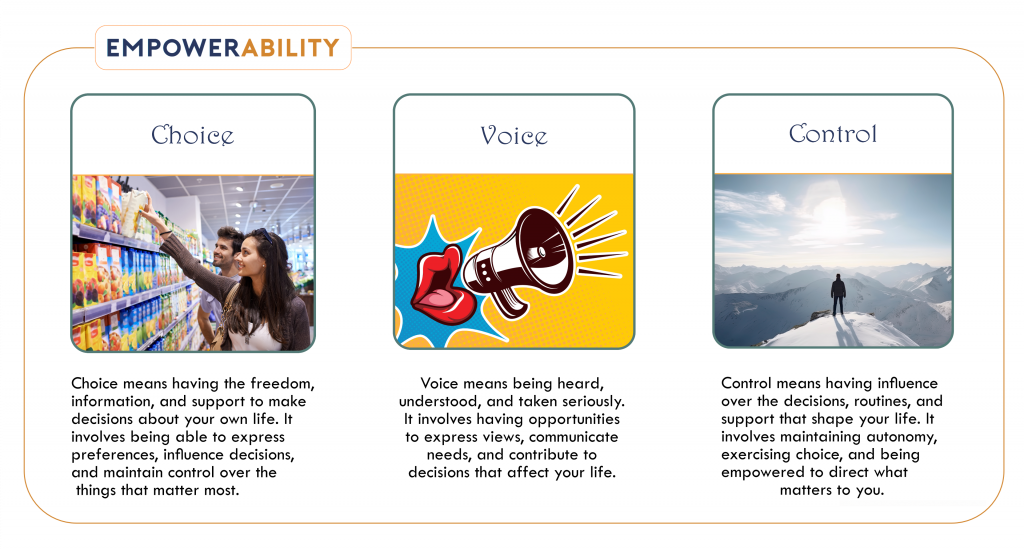
Supporting people to shape their own lives
At EmpowerAbility, we believe people should have genuine influence over the decisions that shape their lives.
Support should never be something that happens to people. It should be something developed with people.
Every person has the right to express their wishes, make informed choices, take reasonable risks, and remain in control of their own life as far as possible.
Even when someone needs significant support, their voice still matters.
What this standard means
Definition
This standard promotes genuine choice, meaningful participation, and as much personal control as possible.
Support should help people make decisions, not replace their decision-making unnecessarily.
Why it matters
When people have little control over their lives, they may experience:
- frustration
- helplessness
- dependence
- loss of confidence
- reduced motivation
- emotional distress
When people have meaningful influence, they are more likely to experience:
- confidence
- independence
- motivation
- wellbeing
- self-esteem
- empowerment
Choice protects dignity.
Voice strengthens identity.
Control supports independence.
Core principle
At EmpowerAbility, we believe people should direct their own lives wherever possible.
Support should remove barriers rather than remove control.
The aim is to enable people to make decisions, not simply make decisions for them.
Understanding choice, voice and control
Choice

Choice means having genuine opportunities to make decisions that matter.
This may include decisions about:
- where to live
- daily routines
- food and clothing
- relationships
- education and employment
- leisure activities
- support arrangements
- future goals
Real choice should never be limited simply because it is more convenient for others.
Voice
Voice means a person’s wishes, feelings, and preferences are heard, understood, and taken seriously.
People communicate in many different ways, including:
- speech
- behaviour
- body language
- gestures
- writing
- symbols
- communication aids
- advocacy
Everyone communicates.
Good support listens carefully.
Control
Control means maintaining influence over your own life.
People should have as much control as possible over their routines, finances, relationships, environment, and future plans.
Support should increase confidence and independence, not create unnecessary dependence.
Required outcomes
People participate in decisions
People should remain at the centre of decisions that affect their lives.
Support should maximise involvement and never assume incapacity without appropriate assessment.
Communication barriers are reduced
Everyone should have access to information and communication that meets their individual needs.
Accessible communication is essential for meaningful choice.
Meaningful choices are available
People should have genuine opportunities to make decisions that matter to them.
Support should widen opportunities wherever possible.
Advocacy is available
People should be able to access advocacy whenever they need help expressing or defending their wishes.
Advocacy protects people’s voices.
Restrictions are minimised
Restrictions should only be used when they are:
- lawful
- necessary
- proportionate
- regularly reviewed
Least restrictive practice should always be the goal.
Independence is encouraged
Support should build confidence, develop decision-making skills, and promote greater independence over time.
Best practice guidance
Offer real choices
Look beyond small everyday decisions.
Ask yourself:
- What really matters to this person?
- What opportunities can we create?
- Are choices genuinely meaningful?
Support decision-making
Some people need support to understand options and make informed decisions.
Use clear explanations, visual supports, extra time, and accessible information whenever needed.
Support should enable decisions, not replace them.
Listen beyond words
Communication is about much more than speech.
Behaviour, emotions, body language, and engagement can all express important preferences.
Take time to understand how each person communicates.
Respect the dignity of risk
A meaningful life involves some degree of risk.
Ask yourself:
- Is this risk reasonable?
- Can risk be reduced without removing choice?
- Are we protecting the person or controlling them unnecessarily?
Good support balances safety with freedom.
Poor practice
Warning signs
Warning signs include:
- making decisions without consultation
- unnecessary restrictions
- limited opportunities for choice
- inaccessible communication
- overprotection
- organisational convenience taking priority
- people becoming passive or disengaged
These concerns should always be reviewed.
Evidence of compliance
Quality may be demonstrated through:
- support plan reviews
- decision-making records
- advocacy involvement
- resident feedback
- observations
- restrictive practice audits
- supervision records
- outcome reviews
Quality should be visible in everyday life.
Reflection
Questions to ask
- Has the person been genuinely involved?
- Have communication barriers been removed?
- Are meaningful choices available?
- Are restrictions truly necessary?
- Are we promoting independence?
- Have we listened to the person’s voice?
Quick summary
Choice, voice, and control are central to person-centred support.
People should have genuine influence over the decisions that shape their lives, and support should strengthen—not replace—their ability to make those decisions.
Key points
- Meaningful choice promotes dignity.
- Everyone has a voice.
- Communication takes many forms.
- Control supports independence.
- Restrictions should be a last resort.
- Great support removes barriers, not opportunities.
Learn more
Related standards
- Standard 1 — Rights, Dignity & Respect
- Standard 3 — Equality, Diversity & Inclusion
- Standard 6 — Person-Centred Support & Outcomes
- Standard 7 — Communication & Relationships
- Standard 8 — Growth, Independence & Realising Potential
Video learning
Coming soon:
- Meaningful choice in everyday life
- Supported decision-making
- The dignity of risk
- Avoiding overprotection
- Helping people find their voice
EmpowerAbility
Empowering lives. Enabling potential.