Designing safe homes for independent living
At EmpowerAbility, we believe a home should do far more than provide shelter.
A home should support people to live safely, comfortably, and with as much independence as possible.
The design of a home influences almost every aspect of daily life.
It affects how a person:
- enters and leaves their home
- moves between rooms
- prepares food
- washes and dresses
- manages routines
- communicates
- feels safe
- maintains privacy
- participates in daily life
Good design can empower.
Poor design can create barriers.
Accessible and inclusive housing seeks to reduce those barriers so people can live with greater confidence, autonomy, and dignity.
Why Accessibility Matters
Accessibility is often misunderstood as simply providing ramps or grab rails.
In reality, accessibility is much broader.
It is about ensuring people can access and use environments, systems, and services safely and effectively, regardless of disability, impairment, or additional need.
At its core, accessibility asks:
Can this person use this home safely, comfortably, and with dignity?
If the answer is no, a barrier may exist.
Barriers can affect people with:
- mobility impairments
- visual impairment
- hearing impairment
- autism
- dementia
- learning disabilities
- acquired brain injury
- chronic illness
- mental health challenges
- temporary injuries
- age-related frailty
Accessibility benefits far more people than is often recognised.
What Is Inclusive Design?
Inclusive design builds on accessibility.
Rather than adapting spaces only after barriers are identified, inclusive design aims to reduce those barriers from the start.
In simple terms:
Accessibility removes barriers. Inclusive design seeks to avoid creating them in the first place.
Inclusive design recognises that people interact with environments differently.
Instead of designing only for an “average” person, inclusive design considers diverse human needs.
This leads to homes that are easier and safer for many people to use.
Examples include:
- step-free entrances
- intuitive layouts
- clear signage
- accessible controls
- strong visual contrast
- safe circulation space
Good inclusive design often benefits everyone.
Core Principle
At EmpowerAbility, we work from a simple principle:
Homes should adapt to people as far as possible, rather than forcing people to adapt to poor design.
Good design removes barriers.
Poor design creates them.
Why Housing Design Matters
Housing design affects daily life in countless ways.
A poorly designed home may increase:
- falls
- fatigue
- confusion
- dependence
- injury risk
- stress
- safeguarding concerns
A well-designed home may improve:
- independence
- confidence
- comfort
- safety
- wellbeing
- dignity
In many cases, the main barrier to independence is not the person’s condition.
It is the environment around them.
This is why housing design matters so much.
Core Principles of Accessible Housing
Good accessible housing is built around several key principles.
Step-Free Access
Access begins before the front door.
Entrances should ideally be step-free or easily navigable.
Important considerations include:
- level thresholds
- ramps where required
- gentle gradients
- slip-resistant surfaces
- adequate lighting
- weather protection
Step-free access improves safety and inclusion.
Safe Circulation Space
People need enough space to move safely.
This is particularly important for:
- wheelchair users
- walking aid users
- carers providing assistance
- people with poor balance
Good circulation reduces collisions and fall risk.
Important considerations include:
- hallway widths
- turning circles
- furniture placement
- clutter reduction
Space matters.
Intuitive Layout
Good layouts reduce physical and cognitive effort.
Ask:
- Are frequently used rooms easy to access?
- Is movement through the home logical?
- Are routes simple and clear?
Good layouts support routine and confidence.
Simple design can be powerful.
Adaptability
Needs change over time.
Good housing should be capable of adapting.
Adaptable homes may accommodate:
- ageing
- injury
- illness
- increased support needs
- assistive equipment
Adaptability reduces the need for disruptive relocation.
Entering and Moving Through the Home
A useful way to assess accessibility is to follow the person’s journey through the home.
Ask:
- Can they enter easily?
- Can they move safely between rooms?
- Can they exit quickly in an emergency?
Every stage matters.
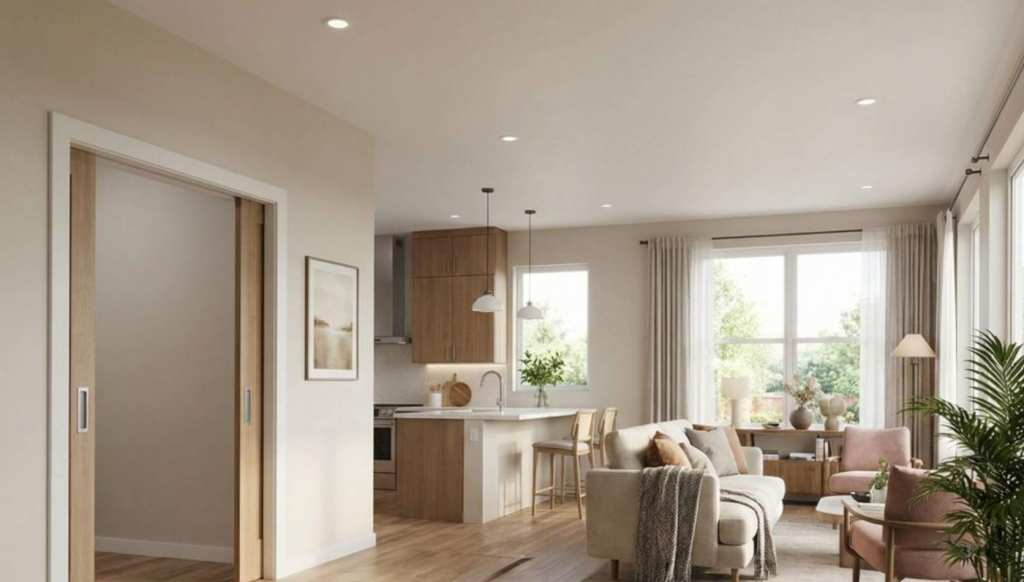
Entrances and Doorways
The entrance should feel safe, welcoming, and easy to use.
Important considerations include:
- door width
- opening force
- handle design
- secure access systems
- visibility
Heavy or narrow doors can reduce independence.
At EmpowerAbility, we strongly support accessible door hardware such as:
- lever handles
- easy-turn locks
- thumbturn locks where appropriate
These can improve both usability and emergency safety.
Stairs and Level Changes
Stairs can create major accessibility barriers.
This may affect people with:
- mobility limitations
- poor balance
- fatigue
- visual impairment
- neurological conditions
Where stairs exist, important features include:
- handrails
- lighting
- visual contrast
- anti-slip surfaces
- future stairlift potential
Future planning matters.
Accessible Daily Living Spaces
Accessibility becomes most visible in everyday routines.
A home should support daily living safely and efficiently.
Kitchens
The kitchen plays a major role in independence.
Accessible kitchens can support safe food preparation and greater autonomy.
Important design considerations include:
- appropriate worktop heights
- reachable storage
- pull-down shelving
- induction hobs
- side-opening ovens
- clear controls
- safe appliance positioning
- knee clearance where required
Kitchen design should reduce strain and improve safety.
Good kitchens support independence.
Bathrooms
Bathrooms are among the highest-risk spaces in the home.
Poor design can greatly increase fall risk.
Accessible bathrooms may include:
- level-access showers
- wet rooms
- grab rails
- shower seating
- anti-slip flooring
- accessible basins
- transfer space around toilets
Bathroom design affects both safety and dignity.
Privacy matters.

Bedrooms and Living Spaces
Bedrooms and living areas should support comfort, rest, and control.
Consider:
- bed positioning
- transfer space
- accessible storage
- reachable switches
- emergency call systems
- lighting controls
Good design supports both comfort and independence.
Storage and Everyday Usability
Storage is often overlooked.
Poor storage creates unnecessary difficulty.
Good storage should be:
- reachable
- organised
- intuitive
- safe to access
Accessibility includes routine daily tasks.
Small frustrations matter.
Sensory and Cognitive Considerations
Accessibility is not only physical.
Homes should also consider sensory and cognitive needs.
This is especially important for people with:
- autism
- dementia
- acquired brain injury
- sensory processing differences
Important considerations include:
- lighting quality
- glare reduction
- acoustic comfort
- colour contrast
- visual clutter reduction
- intuitive controls
Sensory-friendly environments can reduce stress and confusion.
Design influences emotional wellbeing.
Lighting and Environmental Controls
Good lighting improves:
- visibility
- orientation
- safety
- confidence
Poor lighting can increase:
- falls
- confusion
- fatigue
- sensory overwhelm
Environmental controls such as thermostats and lighting switches should be:
- reachable
- clearly labelled
- easy to understand
- intuitive to operate
Technology should simplify life.
Not complicate it.
Safety and Emergency Escape
Accessible housing must also support safety.
A home should allow occupants to respond effectively during emergencies.
Important safety considerations include:
- clear escape routes
- smoke alarms
- visual alarms where needed
- accessible exits
- emergency lighting
- evacuation planning
At EmpowerAbility, we strongly advocate for the use of thumbturn locks or other easy-egress locking systems where lawful and appropriate.
These reduce reliance on locating keys during emergencies and may improve evacuation speed.
A home is not truly accessible if it cannot be exited safely during an emergency.
Safety comes first.
Outdoor Accessibility
Accessibility does not end at the front door.
Outdoor environments matter too.
Important considerations include:
- accessible parking
- pathways
- gradients
- entrances
- seating
- gardens
- communal spaces
Outdoor accessibility supports participation and community connection.
Connection matters.
Future-Proofing Homes
This is one of EmpowerAbility’s strongest principles.
Needs often change over time.
A home that works well today may become unsuitable later.
Future-proof design considers possible changes such as:
- ageing
- reduced mobility
- chronic illness
- increased support needs
- specialist equipment
Future-proofing may include:
- adaptable layouts
- structural reinforcement for future grab rails
- space for lifts or hoists
- flexible room usage
Planning ahead reduces future disruption.
Accessible Housing in Supported Living
This is especially important for EmpowerAbility.
Supported housing should go beyond minimum compliance.
It should actively enable:
- independence
- autonomy
- safety
- participation
- meaningful life
Good supported housing balances:
- accessibility
- homeliness
- safety
- flexibility
- dignity
Homes should feel like homes.
Not institutions.
Common Mistakes in Practice
Accessibility problems often arise from common misunderstandings.
Designing for Minimum Compliance
Meeting minimum standards does not always create genuinely accessible homes.
Aim higher.
Focusing Only on Mobility
Accessibility includes sensory, cognitive, and communication needs.
Poor Layout Planning
Room size alone does not guarantee accessibility.
Flow matters.
Prioritising Appearance Over Function
Beautiful design and accessible design can coexist.
Good design achieves both.
Ignoring Future Needs
Think beyond present requirements.
Plan ahead.
Best Practice Guidance
EmpowerAbility promotes the following best practices.
Design for Independence
Homes should maximise autonomy wherever possible.
Reduce Barriers Early
Prevention is better than retrofitting.
Think Holistically
Accessibility involves the whole living environment.
Prioritise Safety and Dignity
Good design protects both.
Plan for Change
Adaptable homes remain useful for longer.
Benefits of Accessible Housing & Inclusive Design
When housing is designed well, outcomes improve significantly.
Benefits may include:
- fewer accidents
- greater independence
- improved confidence
- reduced stress
- improved safety
- better wellbeing
- increased dignity
- longer-term housing stability
Good housing changes lives.
Key Questions for Reflection
Ask yourself:
- Can the person enter and move around safely?
- Can they use essential rooms independently?
- Are barriers creating unnecessary dependence?
- Could better design improve safety?
- Is the home adaptable for future needs?
- Does the home feel empowering and dignified?
Reflection improves design.
Key Principle
At EmpowerAbility, one principle guides our approach:
Accessible and inclusive housing is about creating homes that quietly remove barriers, enabling people to live safely, comfortably, independently, and with dignity.
This captures the heart of accessible housing.
Homes shape opportunity.
Related Standards
This standard links closely with:
- Standard 1 – Rights, Dignity & Respectl
- Standard 2 – Choice, Voice & Control
- Standard 3 – Equality, Diversity & Inclusion
- Standard 4 – Safe, Healthy & Secure Living
- Standard 6 – Person-Centred Support & Outcomes
- Standard 9 – Governance, Leadership & Quality Assurance
Video Learning
This page will eventually include short EmpowerAbility videos covering:
- What makes a home accessible
- Inclusive design explained
- Accessible kitchens and bathrooms
- Future-proof housing design
- Common housing barriers
EmpowerAbility
Empowering lives. Enabling potential.